




Plant Protection Products and Public Health Protection
MRLs: Plant Protection Product Residues
Plant protection products (PPPs) or pesticides are mainly synthetic compounds used to control a wide range of harmful agents that affect cultivated plants and reduce or inhibit the production of crop products (food, feed, etc.). Plant pathogens include microorganisms (viruses, bacteria, fungi, parasites) as well as larger organisms, ranging from insects to rodents and even wild mammals.
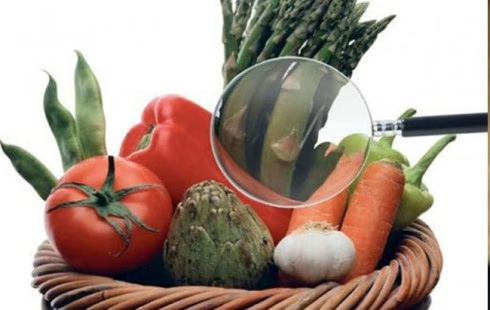
In the current context of economic crisis, one of the main economic sectors showing growth in employment is agriculture. This makes scientifically documented information on the rational use of plant protection products clearly necessary, both to promote the health of the workforce and to safeguard the health of consumers of final crop products.

RESIDUES OF PLANT PROTECTION PRODUCTS IN PLANT AND ANIMAL PRODUCTS (MRLS)
According to Codex Alimentarius (1984), a pesticide residue in food is defined as any substance or mixture of substances found in food for humans or animals as a result of the application of plant protection products, including specified derivatives such as degradation or breakdown products of chemical pesticides, metabolites, and reaction products—i.e. substances of high toxicological concern. Therefore, the presence of residues in agricultural products results from the use of plant protection products either during the various stages of cultivation or during storage.
From production through to the management of plant protection products, four stages should be distinguished:
-
The first concerns the production process and storage within manufacturing facilities.
-
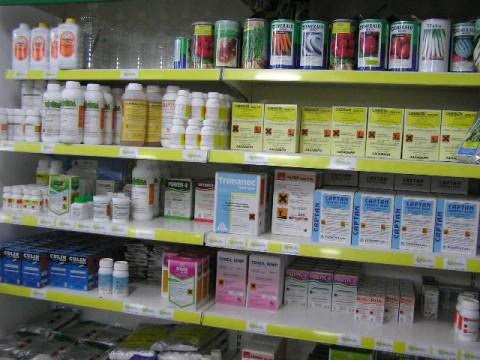
The second concerns the distribution process and safeguarding of these formulations in the so-called points of sale, which essentially are the “agronomic supply businesses”.
-
The third concerns storage, preparation, and the application process by farmers.
-
The fourth, and equally important, stage is the management of residues after use, as well as the final disposal of packaging that is no longer usable.
Packaging used for preparing spray mixtures, if it contains unused material, should be stored in appropriate storage areas. Empty packaging should be collected in designated locations before its final disposal.
In general, we could state that safe work with plant protection products presupposes that:
-
There is no absolutely safe plant protection product, either for humans or for any environmental parameter.
-
They must always be used in accordance with the instructions of the competent authorities.
-
Great care must be taken when preparing the materials to be used for spraying.
-
Personal protective equipment (PPE) must always be worn when using plant protection products.
-
Weather conditions must be taken into account during spraying.
-
Measures must be taken to protect the public, both during spraying and for a certain period of days afterwards.
-
Spraying equipment, whether small or large, must be thoroughly cleaned after spraying is completed.
-
Food or beverages should not be consumed during spraying.
-
Thorough washing after spraying is required, and PPE should also be cleaned to ensure it is safe for future use.
-
Care must be taken for the safe management of residues and empty packaging of plant protection products.
-
Harvesting of agricultural products must always take place only after a certain number of days following spraying and always according to the instructions of manufacturers and agronomists.
-
By following these simple guidelines, the risk from plant protection products will always be reduced both for those who use them and for consumers, as well as for the environment in general.
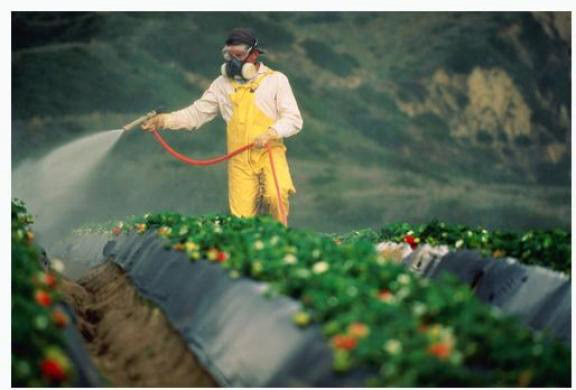
From the moment of application, the active substance begins to degrade under the influence of environmental factors (light, moisture, and temperature), but mainly through the action of enzymes in plant or animal cells. Residues from plants pass to animals, humans, or the environment (soil and especially water). A proportion of those in soil is taken up by plants, another portion is degraded chemically or biologically or adsorbed onto soil colloids, and the remainder is leached with drainage water and may contaminate streams, rivers, lakes, coastal waters, or groundwater.
The concentration of plant protection product residues in food depends on the following:
-
The initial concentration of the product (dose)
-
The frequency of application
-
Its stability
-
Its volatility
-
Its penetrative or systemic capacity
-
Its water solubility or fat solubility
-
The plant growth rate (“biological dilution”)
-
Climatic conditions
-
The time of the last safe intervention (pre-harvest interval).
EU PESTICIDES DATABASE
-
The EU Pesticides Database allows users to search for information on active substances used in plant protection products, maximum residue levels (MRLs) in food products, and emergency authorisations for plant protection products in the Member States. Users may use the following search options to find information:
The database contains information on active substances (including low-risk substances and candidates for substitution) and basic substances, whether approved or not approved in the EU. Certain safeners and synergists are also listed, although they have not yet been evaluated at EU level.
You can find the latest updates related to active substances .
-
Food products
Users can search for a specific food commodity (e.g. oranges) and retrieve the maximum residue levels (MRLs) applicable to all pesticide residues for that product. -
Pesticide residues and the MRLs applicable to such residues in food.
Traces of pesticides left in processed products are referred to as “residues”. The maximum residue level (MRL – Maximum Residue Limit) is the highest level of a pesticide residue that is legally tolerated in food or feed when pesticides are applied correctly (Good Agricultural Practice). Users can select a specific pesticide residue in specific foods and find the current or historical MRLs that apply legally. Users can also download MRL data .
- Residue levels found in food must be safe for consumers and should be as low as reasonably achievable.
-
The European Commission sets MRLs for all food and feed.
-
MRLs for all crops and all pesticides are available in the EU Pesticides Database .
-
Emergency authorisations for plant protection products in the Member States of the European Union
The database includes emergency authorisations granted in accordance with Article 53 of Regulation (EC) No 1107/2009 by the Member States since June 2016. Users can search using various parameters to identify relevant emergency authorisations.
The EU Pesticides Database provides details on authorisations granted by Member States as entered into the Plant Protection Product Application Management System (PPPAMS). Member States are fully responsible for granting emergency authorisations. The information provided is the sole responsibility of the respective Member State; therefore, any questions relating to specific authorisations should be addressed directly to the competent authority of the relevant Member State .
-
What happens if the required MRL is not considered safe?
It is set at the lowest analytical limit of determination (LOD). This value also applies to crops in which the pesticide has not been used or where its use has not resulted in detectable residues.
The default lower limit (LOD) under EU legislation is 0.01 mg/kg.
The 4 main categories of substances with respect to MRLs
They have:
- authorised uses
- established MRLs per crop/commodity
- GAP (Good Agricultural Practice)
- residue trials
- ADI / ARfD
This is very common and often causes confusion.
Examples: DDT, Aldrin / Dieldrin, Vinclozolin, Parathion, Endosulfan
This applies because:
- MRLs are used:
- to control imported products
- to detect illegal use
- they are usually:
- LOQ-based (e.g. 0.01 mg/kg)
3. Substances listed in Annex IV (No MRL required)
This category includes: basic substances, natural products, microorganisms, pheromones
Characteristics:
- no MRL is required
- not because they “leave no residues”, but because:
- there is no toxicological concern
- or residues are not considered relevant
- microorganisms (Trichoderma, Bacillus, etc.)
- pheromones
- acetic acid
- sucrose
- plant oils (in specific cases)
- Examples: nutrients (N, P, K), nitrates, calcium, iron, CO₂, oxygen, urea (when used as a fertiliser)
- Regulated under: food safety, environmental pollution, nutrition
Legislation on residues of plant protection products in food
by the Ministry of Rural Development & Food
- EU MRLs based on Regulation (EC) No 396/2005 (EU Pesticides Database)
- Regulation (EC) No 299/2008 amending Regulation (EC) No 396/2005 on maximum residue levels of pesticides in or on food and feed of plant and animal origin, as regards the implementing powers conferred on the Commission
- Regulation (EC) No 396/2005 and amendments
- Chlorate
- Table of amendments to Annexes II, III, IV of Regulation (EC) No 396/2005 (16.10.18)
- Guidance documents
- EU MRLs based on Regulation (EC) No 396/2005 (EU Pesticides Database)
- Law 4036/2012 with incorporated amendments